Small Bugs, Big Impact
Working with Naibunga Conservancy to eradicate prickly pear, one cactus at a time
Some of the most important conservation work happens quietly, plant by plant and season by season, and sometimes it begins with something as small as an insect.
Across the rangelands of Laikipia, an invasive prickly pear cactus, Opuntia engelmannii, has been spreading steadily through community lands and conservancies. Left unchecked, it crowds out native vegetation, blocks access to grazing, and chips away at the health of the ecosystems that people and wildlife depend on. For the communities of the Naibunga Community Conservancies, it is a daily, tangible threat to livestock, livelihoods, and the land itself.
This month, the Kenya Rhino Range Expansion Initiative partnered with CABI, a non-profit organization, and the women of the Naibunga Community to turn the tide, and to do it the way good conservation should be done: led by science and owned by community.
A natural solution, already proven
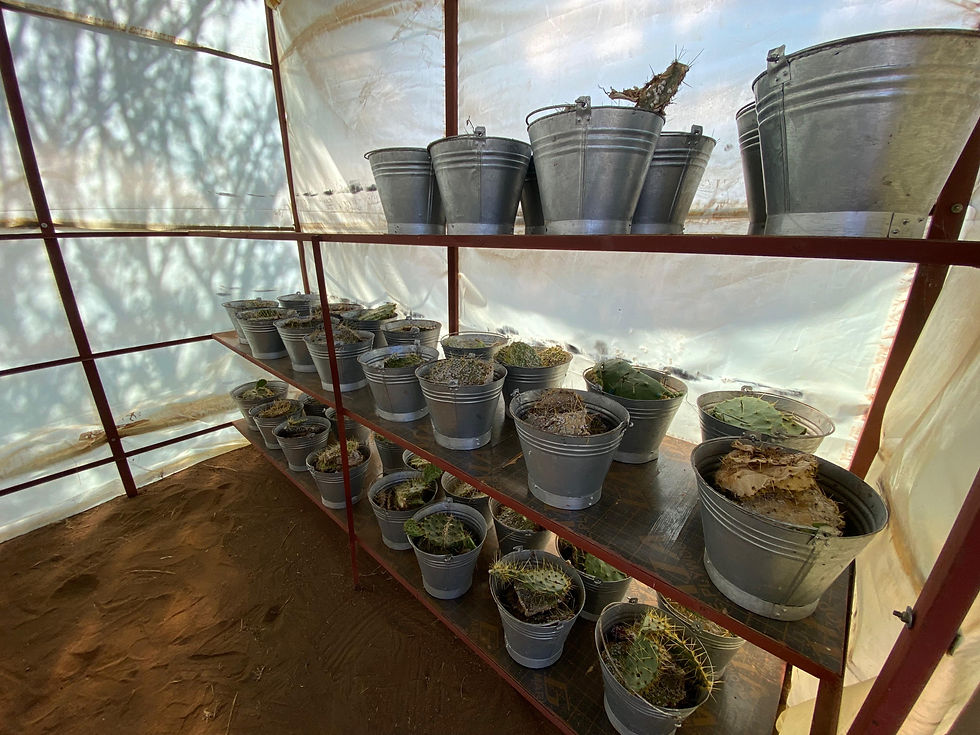
The project will be implemented by CABI (https://www.cabi.org/) (the Centre for Agriculture and Biosciences International) and the community members that run critical greenhouses throughout the Naibunga region. CABI is known for its deep technical expertise in invasive species management. Rather than relying on chemicals or exhausting manual clearing, the work uses biological control: the careful, targeted release of cochineal insects, a natural agent that feeds only on Opuntia and suppresses its spread. CABI’s technical know-how is then carried out by members of the local community - an approach that blends science and local stewardship.
This is not a leap into the unknown. The same approach has already proven hugely successful against Opuntia stricta in Laikipia, and CABI has been building the foundations in Naibunga for some time. Seven cochineal rearing houses, managed by the community, are already up and running. These are small but mighty production sites where the biological control agent is reared, then released into invaded areas across five planned release cycles through the year.
A project built by the community
What makes this work powerful is who is doing it. When CABI held community consultations in early 2024, support was unanimous, and the willingness to take part, particularly among women, was striking. That energy is now built into the heart of the project.

Seven women care for the seven rearing houses, restocking them, protecting them from livestock damage, and tracking progress month by month. Local participants are hired to collect and prepare the plants, carry out the release of the bugs, and monitor results. Review workshops bring the community back together to assess what is working and adapt where needed. This is conservation rooted in local ownership, exactly the model Naibunga’s conservancies have long championed, where communities are not beneficiaries of conservation but its stewards and decision makers.
How KRRE is showing up
KRRE is supporting this work with a grant of approximately $15,000, funding that covers the rearing houses, release cycles, community participation, monitoring, and an annual review.
But our role goes beyond funding. As with all KRRE partnerships, we bring technical guidance, oversight, and a commitment to measuring real impact. Progress will be tracked through reviews and monitoring data, feeding into the same wider picture we are building across Central Laikipia. The project is supported by KRRE and owned by the Kenya Wildlife Service (KWS), part of a coordinated effort to restore habitat and integrity to these landscapes.
Why it matters
Healthy rangelands are the foundation of everything we do. Before rhinos can return to a landscape, that landscape has to be able to sustain them, along with the wildlife and livestock that share it. Pushing back an aggressive invaders like Opuntia restores grazing, rebuilds biodiversity, and strengthens the ecological resilience that rhino range expansion ultimately depends on. Naibunga is one of the key community blocks where this groundwork is underway.

There are days when KRRE is making headlines creating new sanctuaries and moving rhino to new homes, but just as important are these seemingly smaller victories, restoring habitats hand-in-hand with the communities that steward them


Comments